Launch priceThree books, one payment, today
United States · High school, AP and first-year

You Don't Have to Memorize the FormulasTo Finally Understand Physics

Physics is a visual subject and it gets taught in paragraphs. Ninety-five pages with one idea on each, drawn — plus 104 terms and 30 revision cards, free.
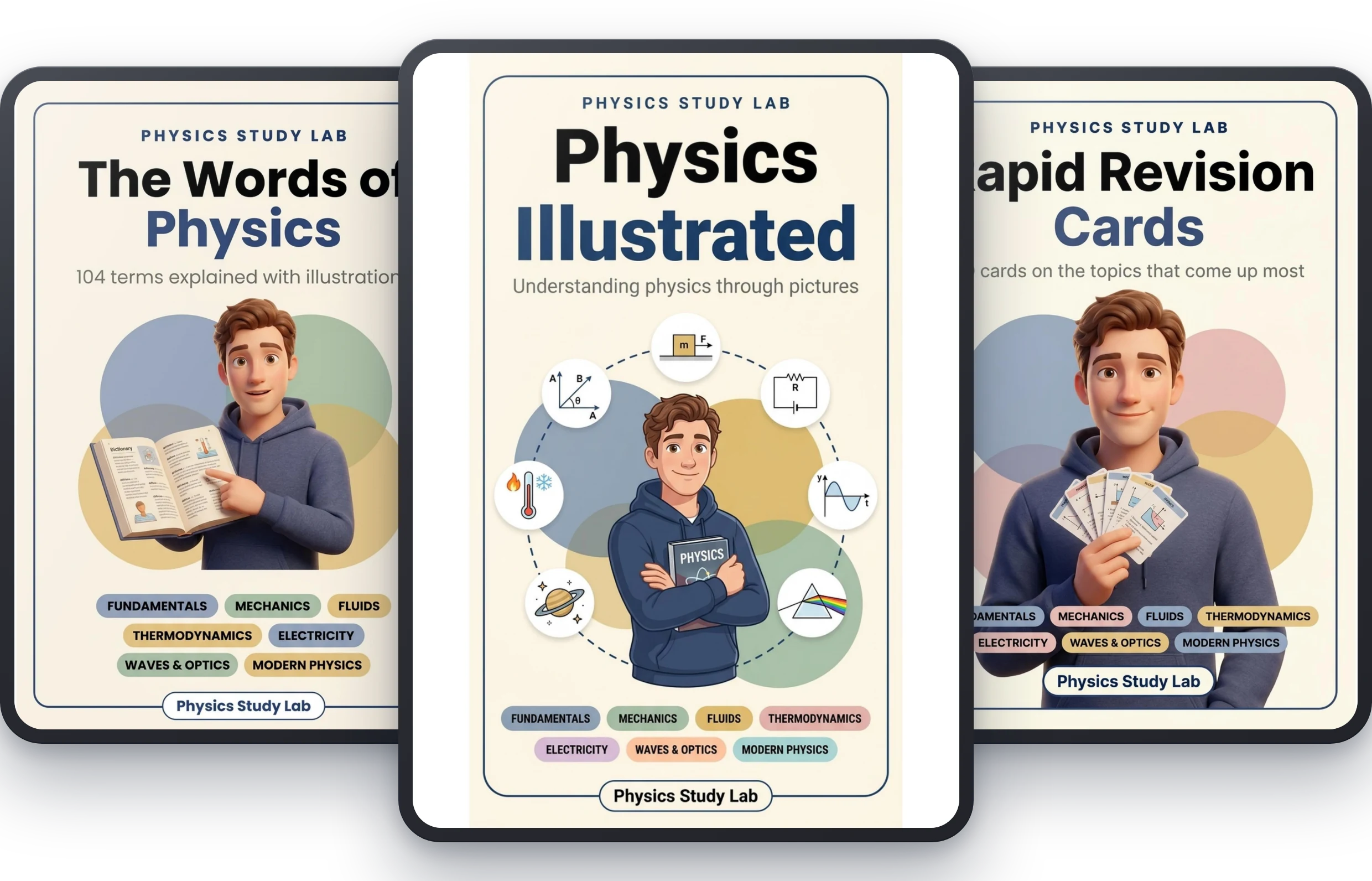
The three books: Physics Illustrated, The Words of Physics and the Rapid Revision Cards
  • One idea per pageThe drawing carries it. The words are the caption.
  • Definition, unit, formula, exampleEvery page, the same four things, in the same place.
  • In your hands in two minutesThree PDFs by email. Read them on your phone or print them.
Show me a page
Secure checkout Instant download 30-day refund policy
95illustrated pages,
one idea each
7parts, vectors
to the atom
3books: the kit,
with both bonuses
Look inside

This Is What a Page Actually Looks Like

Not a wall of text with a diagram bolted on. Tap any page to read it full size.

The real problem

You Read the Chapter Three Times
And Still Can't Start

That is the part nobody explains. You are not lazy and you are not bad at physics. You read it, you followed every sentence, and then the problem set asked you to do something and there was nothing in your head to do it with.

It happens because physics is a visual subject that gets written down as prose. A field, a wave, a current, a vector — those are pictures. Turn a picture into three paragraphs and the reader has to turn it back, alone, before they can use it.

So this book does the turning back for you. One idea per page, drawn: what it is, the unit it is measured in, the formula, and one worked example.

You were never bad at physics.
You were reading it instead of seeing it.

The difference

A Chapter You Reread vs. A Page You Remember

The textbook chapter

  • Twelve pages of prose for one idea
  • The formula arrives before the picture
  • Units mentioned once, in passing
  • You finish it and still can't start question one

This book

  • One page, one idea, drawn
  • The picture first, the formula underneath it
  • Definition, unit, formula and a worked example, every time
  • You close it knowing what to do
The kit

One Book to Understand It.
Two More to Keep It.

The book is the course, drawn. The other two are what you use the week of the test — and they come with it, free.

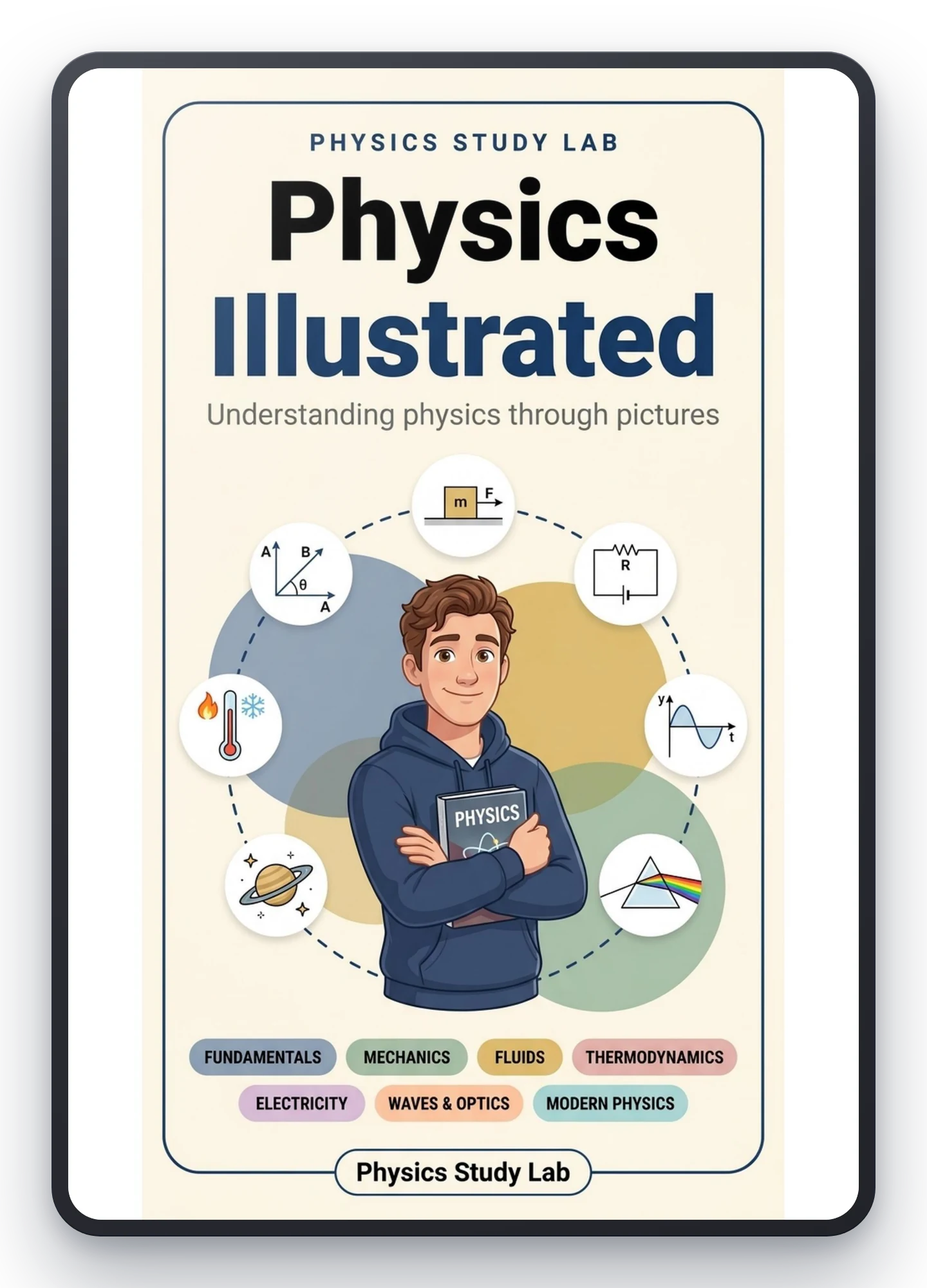
The book Physics Illustrated

Physics Illustrated

95 pages across seven parts, from vectors to the atom. Every page gives you the definition, the unit, the formula and a worked example.

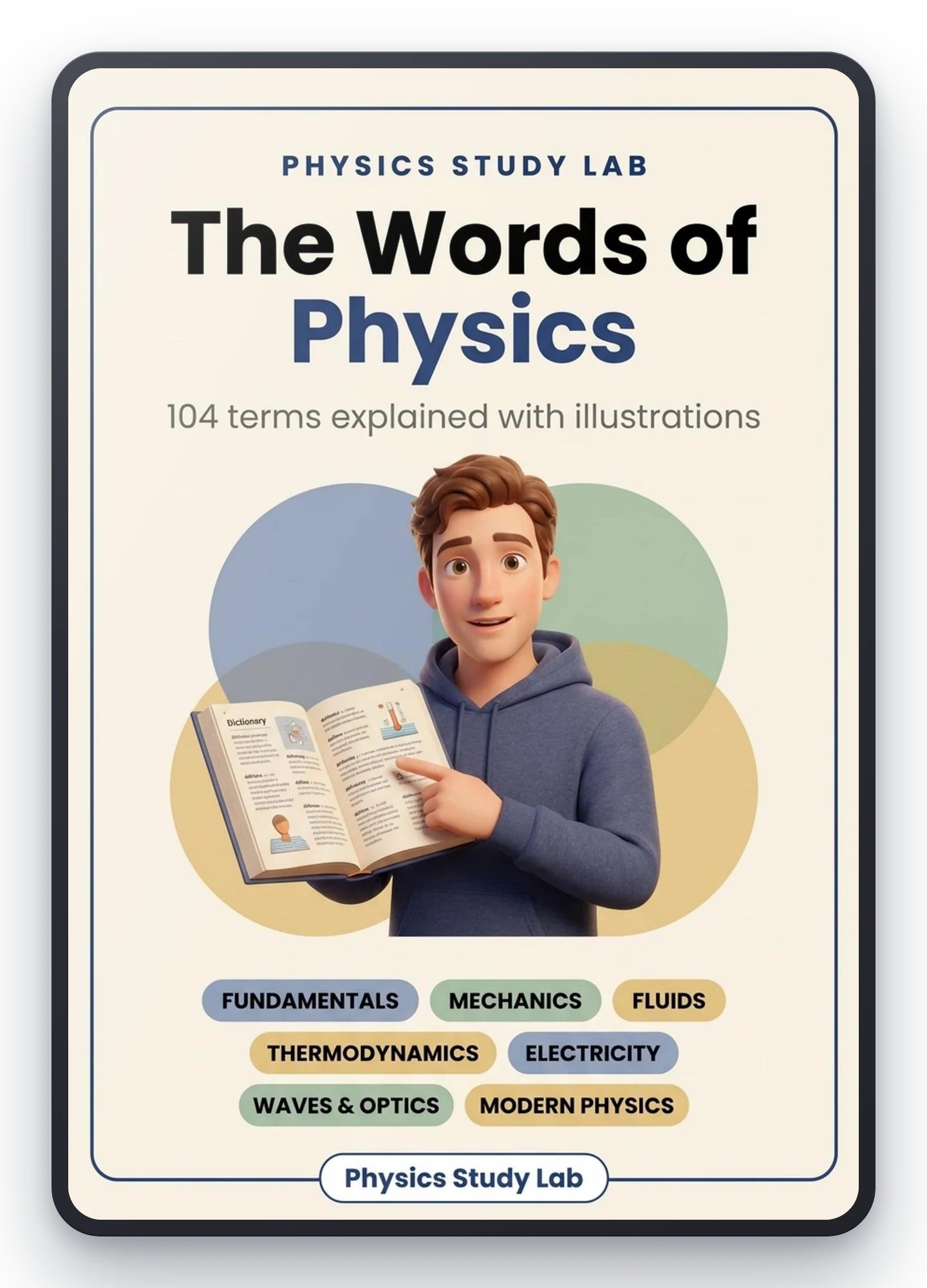
Bonus 1 The Words of Physics

The Words of Physics

104 terms, each with its own drawing. Most of what looks like not understanding physics is not knowing the word.

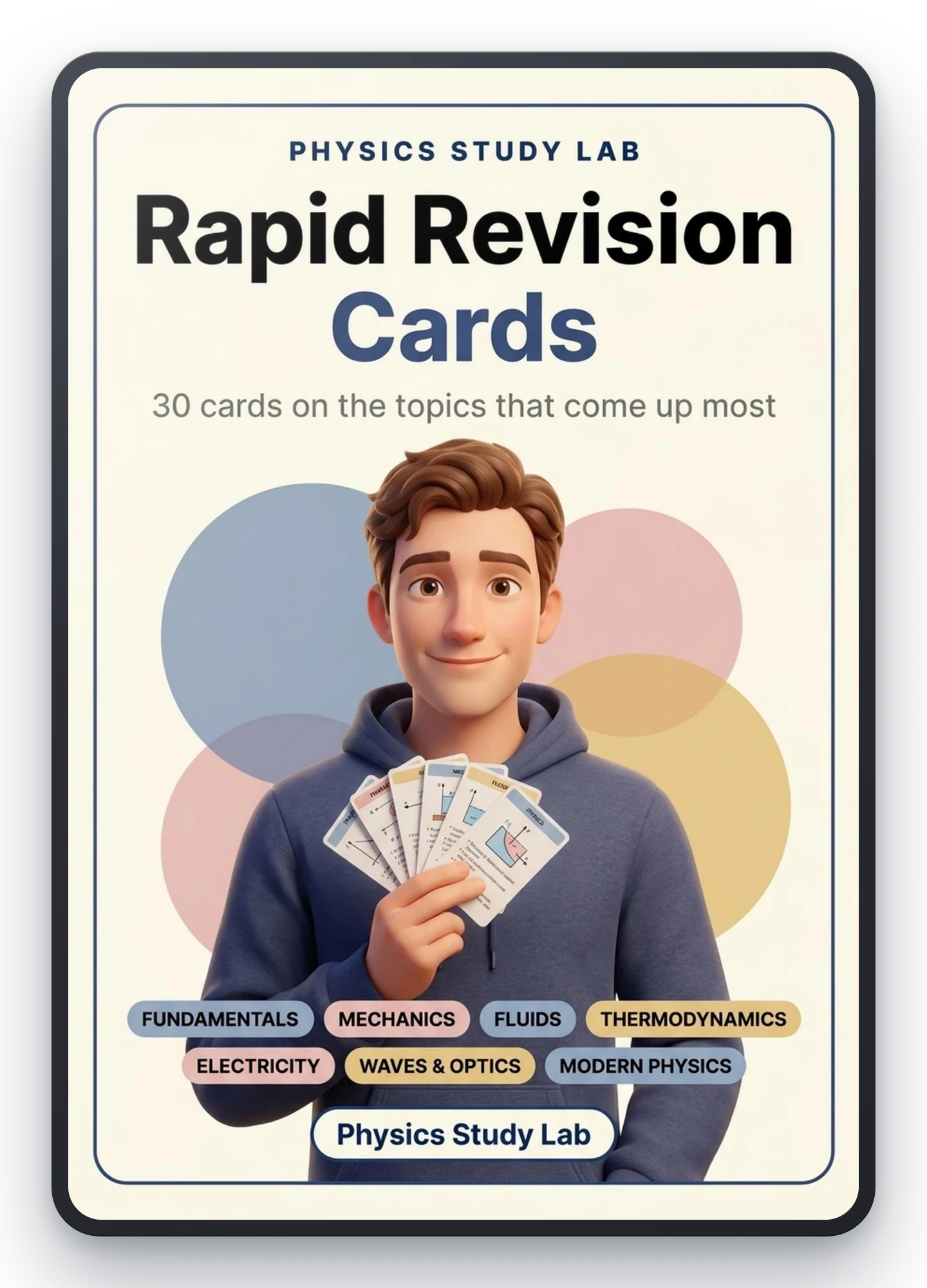
Bonus 2 Rapid Revision Cards

Rapid Revision Cards

30 cards on the topics that come up most: one equation, three facts and one exam tip each. Two to a page, with a line to cut along.

I want the kit — $27
What is inside the book

Seven Parts, Vectors to the Atom

I

Fundamentals

Quantities, units, prefixes and vectors — the grammar you need before any of the rest of it can mean anything.

II

Mechanics

Motion, force and Newton's laws, then energy and momentum. The part the whole course is built on.

III

Fluids

Pressure, density, Pascal, Archimedes and Bernoulli, each one in an everyday example you can picture.

IV

Thermodynamics

Heat, temperature, gases and entropy — without formulas floating on the page with nothing attached to them.

V

Electricity

Charge, field, current, resistance and circuits, one idea at a time, with the circuit drawn next to what it does.

VI

Waves and optics

Sound, light, reflection and refraction, with the diagrams that make the difference between knowing it and seeing it.

VII

Modern physics

Relativity, the quantum, the atom and radiation. Plus a glossary and an index that tells you the page for every topic in the book.

How you use it

The Week Before the Test

You do not read this book cover to cover. You read the part you are on.

Day
1

Read the part you are on

Not the whole book. Find your unit in the index and read those pages — it is a few minutes, because there is one idea on each.

Days
2-3

Learn the words

Open the first bonus and go through the terms for your unit. Most of what looks like not understanding physics is not knowing the word.

Days
4-5

Say the page out loud

Cover the page and say the definition, the unit and the formula. If you can do that, you can start a problem.

Day
6

Cut out the cards

The 30 revision cards: one equation, three facts and one exam tip per card. Print them, cut them, keep the ones for your unit.

Day
7

Go back to the problems

Now open your problem set. The reason you could not start it was almost never the maths.

Is this for you

Who This Was Drawn For

You are taking physics this year

High school, honors or AP. You are keeping up in class and losing it the moment you sit down with the problem set on your own.

You are in your first year of college

The lecture moves at a speed that assumes you already saw this in high school. This is the seeing-it part, and you can do a unit in an evening.

You are buying it for your kid

They will not read another dense textbook. They will read a page with a drawing on it, which is the whole reason this book is shaped this way.

Be clear about it

What This Is, And What It Isn't

What it is: a visual book that makes physics make sense. One idea per page, drawn rather than described, across the seven parts every introductory course goes through. You find your unit in the index, read those pages, and go back to your work understanding what you are doing.

What it isn't: a problem book. There are no exercise sets in it and it will not do your homework. It is also not a course and not a replacement for your class — it is the material that makes your class land.

If what you need is problems worked line by line, that is a different book of ours called Physics Solved, and you can add it at the checkout for $9.90.

The offer

Everything You Get, For One Payment

The complete physics kit

The three books
  • ✓The book: 95 illustrated pages
  • ✓Bonus 1: The Words of Physics, 104 terms Free
  • ✓Bonus 2: 30 Rapid Revision Cards Free
  • ✓High-resolution PDF, made to print Included
  • ✓Print it as often as you want Included
One payment$27
Get the kit — $27
Secure checkout Instant download 30-day refund policy
All three PDFs arrive by email within minutes. One payment, no subscription.

30
days

If something is wrong with it, you get your money back

For 30 days. If a file does not open, if what you received is not what this page describes, if you were charged twice or the download never arrived, write to us and we refund you in full.

One email to info@studiofacilebook.com is enough.

Questions

Before You Decide

Is this for AP Physics, or for regular high school physics?

Both, and for a first-year college course too. It covers the seven parts every introductory physics course goes through, from vectors to the atom. It is not built around one syllabus, which is exactly why it works whichever one you are on — you find your unit in the index and read those pages.

Does it replace my textbook?

No, and it is not trying to. Your textbook has the depth and the problem sets. This is the part your textbook is worst at: showing you the thing instead of describing it. Most people use it to understand the chapter first and then go back to the textbook.

Does it have practice problems?

The main book does not — it is there to make the idea land. If what you want is problems worked line by line, that is a separate book called Physics Solved, and you can add it at the checkout.

How much maths do I need?

Less than you think, and the book never hides it. Where a formula needs rearranging, the page shows the rearranging. If algebra is what is costing you marks, the Maths Toolkit at the checkout is the ten skills every formula needs.

How do I get it?

By email, straight after you buy. Three PDFs you can read on your phone or print.

Can I print it?

Yes, as many times as you want, for yourself. The revision cards are made to be printed and cut out.

One Last Thing

Nobody fails physics because the ideas are too hard.

They fail it because the ideas arrived as paragraphs, and a paragraph is a terrible way to show somebody a field, a wave or a force.

Ninety-five pages.
One idea on each.

Get the kit — $27
All three PDFs by email in minutes